|
|
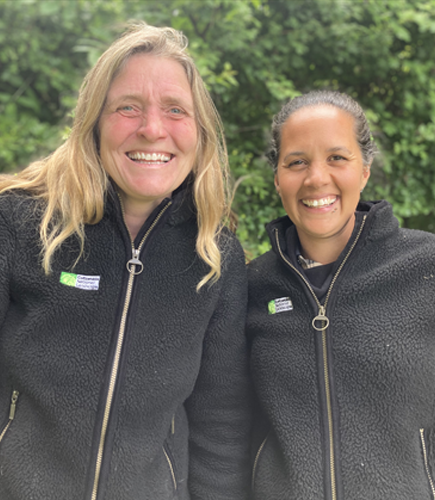
Nicole Daw, Trails and Access Officer, and Ros Marsden, Education Officer, at the Cotswolds National Landscape |

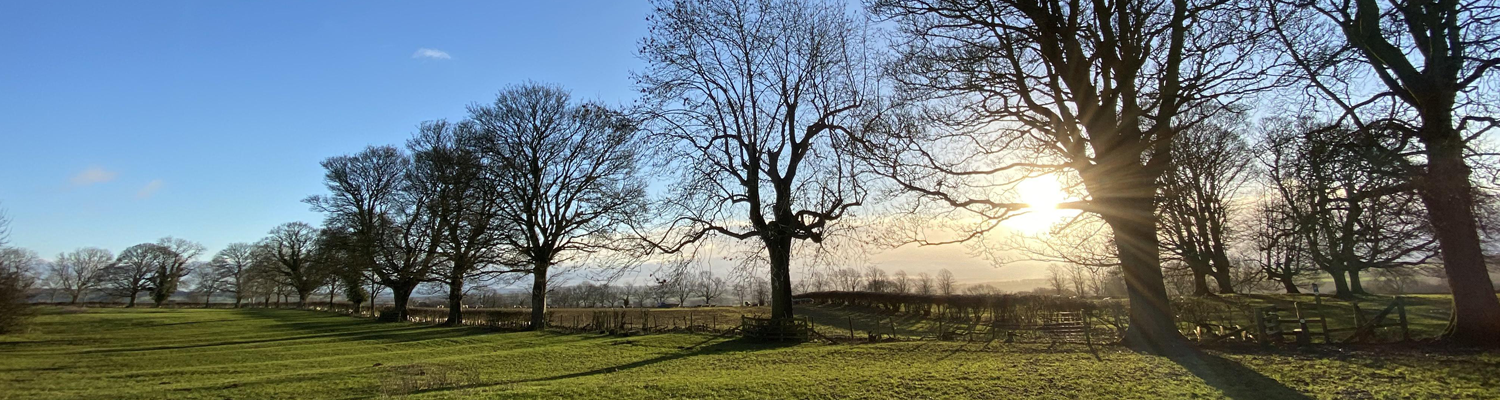
The Cotswolds National Landscape (CNL) is the largest designated Area of Outstanding Natural Beauty in the UK, covering a large area from south of Bath in Wiltshire up to Warwickshire and over to Oxfordshire in the East.
This protected landscape is rich in habitats, heritage and opportunities for outdoor learning! Looked after by a small team in partnership with other organisations and an invaluable team of volunteers, we work with an underpinning principle that this landscape is for everyone, from all walks of life.
As a result, community engagement through formal and informal learning opportunities in the Cotswolds is vitally import to us.
Working with secondary schools
Current GCSE specifications for the sciences do not include a requirement for any fieldwork but we haven’t let that stop us! By using the mandatory need for fieldwork for Geography GCSE, we have had remarkable success. This has had unforeseen sustainable transport benefits too, as locations much closer to the inland schools of Oxfordshire and Gloucestershire – who have traditionally travelled long distances to the coast for their fieldwork – are now used.
River field work and catchment tours
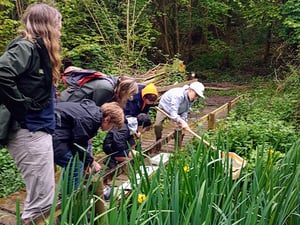 As well as offering standard river surveying, we have included elements on water quality. Added to this, and with an eye to the water cycle and flooding as subject areas, we do a catchment tour of the valley surrounding the river. We discuss how the management of floodplain meadows, fields and woodlands on the valley sides can profoundly influence soil health, water quality, flooding and the river eco-system. We also look at local natural flood management projects, and we physically walk over bunds, around retention ponds and bridge the leaky beaver analogue field-ditch dams. This helps students get a real sense of these structures within the landscape and it is easy to then talk about flood mitigation, as well as the abundance of wildlife that has been drawn to these seasonal ephemeral wetlands. Footage from camera traps or downloaded photos from camera posts overlooking the ponds aid with this.
Such sessions work at both GCSE and A Level.
Habitat comparisons
We are lucky enough that Combe Mill, near Oxford, boasts river, floodplain, pond and contrasting woodlands. We do several experiments as we walk through the landscape, including infiltration rates using infiltrometers and interception of precipitation studies.
The coniferous Western red cedar plantation – with its impoverished acidic mor-humus soils and dark understorey – is compared with the ‘natural’ deciduous hazel coppice, with oak standards woodland that is adjacent to this. Human woodland management is a topic of conversation. This is enhanced by multi-sensory experiences for students to help information recall, handling and smelling the rich mull humus soil under the native trees.
Students use a multi-function environment meter to record levels for light, (natural) sound, humidity and temperature to encourage their thinking about how environmental factors affect understory plant cover, and the presence or absences of associated wildlife, especially birdlife. In addition, invertebrate life is explored and used to indicate the increased biomass that is sustained in the native woodland.
Duke of Edinburgh volunteering - habitat management
Engaging with older students at Key Stage 4 and 5 has been trickier within a school setting. However, we have overcome this is by engaging pupils in their extra-curricular time and encouraging them to volunteer through the Duke of Edinburgh’s Award, engaging in habitat management at weekends or after school.
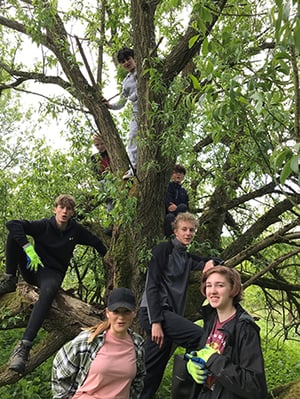
Our group, which has included students from six different schools from Years 9 to 13, have completed path maintenance, tree guard removal, fascine willow-weaving, coppicing, hedge-laying and tree grafting – all with independent study to back up their science learning and support the sessions. They are now adept at tree identification and knowledgeable about rural skills.
School led citizen science
Everyone within the conservation field is aware of the importance of individual citizen scientists, helping with data collection and giving thousands of hours to research projects and environmental campaigns. We have extended this idea to include younger children by rolling out our FreshWater Watch water quality monitoring scheme from Earthwatch. You can find out more about Earthwatch’s education resources here.
Whole schools have been signing up eco-groups to collect data once a month on their local streams or rivers, and providing them with wall charts so their results can be seen by the whole school community. This learning and environmental awareness can be reinforced through assembly presentations to include pupils who may not be involved in the data collection itself.
Other outdoor learning in the CNL
Young people struggling to work within a normal indoor school environment due to mental health issues, special educational needs or feeling disaffected are often transformed in outdoor environments. We have found sessions that include fire lighting using ancient techniques, damper making and cooking, and river safaris using waders to explore streams from within the water course have been particularly successful. Such sessions can be the beginning of more structured and curriculum-orientated programmes of outdoor learning.
There is benefit to walking pupils from their school grounds into local parks, nature reserves or countryside – they can gain a sense of belonging and engagement through seeing familiar environments with fresh eyes. The walk can be part of the learning, as you can discuss the hedgerow wildlife corridors, the birdlife or trees on the way. Don’t be in a hurry to reach your destination!
We know taking students outside of the classroom for learning can be both daunting and a logistical headache! To help enable local schools and groups to try and overcome these barriers we have a team of dedicated volunteers, our Cotswold Voluntary Wardens, who support school visits. Many of them are ex-teachers, while others are specialists in their fields with a genuine passion for inspiring the next generation. Other places you could look to for volunteer support could be your local county Wildlife Trust, Ramblers Groups, community groups that support local nature reserves, parks or orchards, or even Scouting/Guiding centres.
Resources
Another way we support local schools is through the supply of resources. This may be in hard copy, for example through freshwater identification guides, natural history book collections or downloadable resources, such as our Young Cotswold Way Explorers Pack. This pack will be expanded year on year, and includes curriculum linked lesson plans for learning in different habitats.
External resources we use and love include:
- National Library of Scotland side-by-side mapping
- Forestry Commission ‘Tree Identification and Timber Use’ guide – free guide available at Forestry Commission visitor centres
- Lincolnshire Tree Guide
The GCSE in Natural History
CNL was excited to hear a GCSE in Natural History was going to be a choice for future generations. It shows that learning about wildlife and habitats has value and importance – something those of us who have the privilege of working in this sector already know, but many overlook.
To empower young people with knowledge about our natural environment means they can go on to learn more, research more and make more of a positive impact for nature into the future. Many studies show that being outside and having a close connection to nature are good for our physical and mental health. We also have a responsibility to look after and not just negatively affect our world.
This GCSE will allow young people to explore what is beyond their doorsteps with eyes wide open to the wonders of nature. We could not be more delighted to be involved!
Nicole Daw, Trails and Access Officer, and Ros Marsden, Education Officer, at the Cotswolds National Landscape.
Keep up to date with our proposed GCSE in Natural History and other Cambridge OCR Natural History news by signing up our email newsletter and updates. You can read back issues of our Natural History newsletter here.


