Joseph Keating is a Lecturer in the School of Biological Sciences at the University of Bristol and Co-Director of the Bioinformatics MSc programme. His research focuses on the evolution of anatomical traits in both living and fossil organisms, with a particular emphasis on the early evolution of vertebrates. Joseph currently serves as Education Officer for the Palaeontological Association and is a member of the Steering Committee for the diamond open-access journal Open Palaeontology.
The confirmation that Natural History will launch as a new GCSE marks the culmination of years of campaigning by educators, scientists and environmentalists, and is a genuine victory for science education. With the Department for Education's consultation on subject content now underway, the Palaeontological Association welcomes the opportunity to help shape what that qualification looks like.
As Europe's largest professional society for palaeontology, our mission is to foster an inclusive community that explores and shares life's history through research, advocacy and education. We believe palaeontology's unique deep-time perspective – understanding how life, environments and climate have changed over hundreds of millions of years – should be central to the new GCSE.
Natural History is rich with competing claims on curriculum space. Ecology, botany, zoology and behaviour all have legitimate places in a Natural History qualification. But without a deep-time perspective, students will encounter only a snapshot of Earth's history represented by species alive today. Palaeontology provides that missing historical perspective, revealing why life looks the way it does, why some groups dominate and others have vanished, and how ecosystems respond when the world changes around them. We see four areas where its contribution is irreplaceable:
1. Fossils are vital for telling geological time. Every species eventually goes extinct, but some survive far longer than others. Certain species that evolved rapidly, existed briefly and were widely distributed make excellent time markers. If these fossils appear in different rock formations, geologists can infer those rocks are of similar age, even on opposite sides of the world. This is the basis of biostratigraphy: determining the relative age of rocks from the fossils they contain (Fig. 1). Biostratigraphy underpins our understanding of Earth's history and has proved commercially invaluable. It is one of the principal tools that made oil and gas exploration possible, but it is equally important for geological mapping, groundwater studies and identifying suitable reservoirs for carbon capture and storage.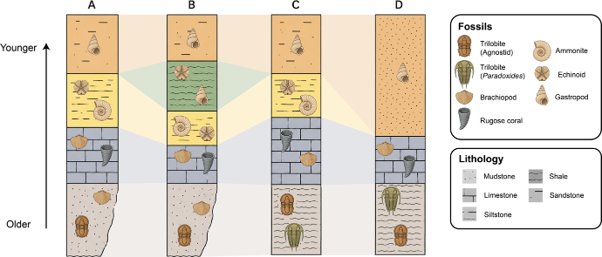
Figure 1. Fossils help date and match rock layers. Four rock columns (A–D) from different places show different sequences of rocks. By comparing the fossils found in each column, geologists can identify rock layers that formed at the same time, even if the rocks look different or parts of the sequence are missing. The coloured bands show the matching time intervals.
2. Fossils provide key evidence for evolution. When Darwin proposed evolution by natural selection, fossils were among his key lines of evidence. They remain fundamental today. Over 99% of all species that have ever lived are now extinct, and fossils give us access to this missing history; documenting the appearance, diversification and extinction of life through deep time. Because fossils preserve anatomical detail within datable rock layers, scientists can test evolutionary hypotheses directly. The results have been revelatory: fossils have shown how fish gave rise to limbed vertebrates (Fig. 2), how aquatic green algae colonised the land and became plants, and how dinosaurs transformed into birds. Without them, these transitions — some of the most important in the history of life — would remain invisible to us.
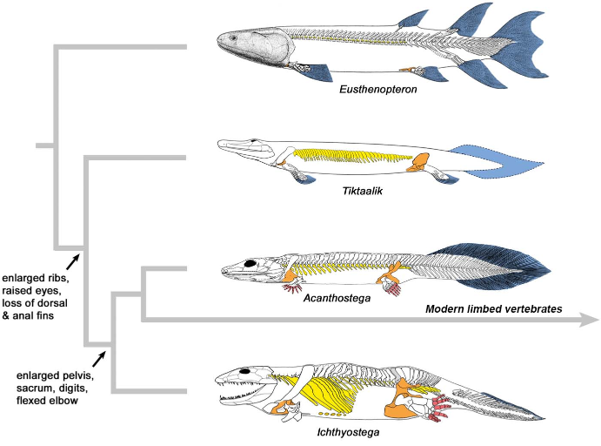
Figure 2. Evolutionary tree showing the transition from fish to limbed vertebrates (tetrapods). Modified from Ahlberg, P.E. (2018).
3. Fossils reveal how biodiversity responds to mass extinctions. Earth's history is punctuated by five major mass extinctions, each eliminating vast numbers of species and fundamentally reshaping life (Fig. 3). The fossil record provides our only direct evidence of how biodiversity responds to these crises. It documents extinction, survival and recovery, and reveals why some groups vanished while others persisted. The end-Permian mass extinction (252 million years ago) eliminated around 80% of species and fundamentally reshaped marine ecosystems. The end-Cretaceous extinction paved the way for the diversification of modern mammals and birds. Fossils demonstrate that rebuilding complex ecosystems after mass extinctions typically takes millions of years, helping us understand the scale and urgency of today's biodiversity crisis. This deep-time perspective is directly relevant to conservation planning and environmental management. By revealing how ecosystems functioned before recent human impacts, fossil evidence can help guide habitat restoration, species reintroductions and biodiversity recovery.
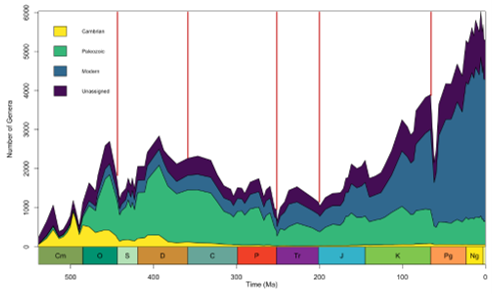
Figure 3. Changes in the diversity of marine animals over the past 500 million years. The coloured regions show three major evolutionary faunas—broad groups of marine animals that dominated Earth's oceans at different times in history. The red vertical lines mark the "Big Five" mass extinction events. Modified from Sepkoski Jr, J.J. (2002).
4. Fossils provide evidence for past climates and help predict future change. From ice ages to times when forests reached the poles, the fossil record shows that Earth's climate has changed dramatically throughout its history (Fig. 4). Fossils allow scientists to reconstruct these past climates and use them as natural experiments to understand how species and ecosystems respond to environmental change. They provide the only direct evidence of these responses over timescales spanning thousands to millions of years. Comparing this record with changes occurring today, scientists can test ecological hypotheses and improve predictions of future change. It also establishes a critical baseline to measure the rate and magnitude of today's anthropogenic climate change.
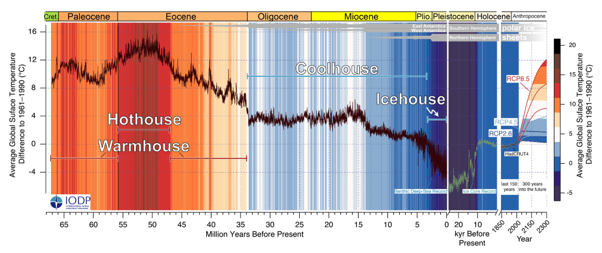
Figure 4. Changes in global average temperature over the past 67 million years, together with projected future warming under different greenhouse gas emission scenarios. The figure shows that, if emissions continue unabated, Earth's climate could return to conditions not experienced for tens of millions of years. Reproduced from Westerhold et al. 2020.
There can be no Natural History without history. Fossils are Earth's natural historical record, preserving the evidence that reveals how the living world came to be. The new GCSE provides a unique opportunity to place today's natural world in its deep-time context, helping students understand not only the world around them, but the history that shaped it and the future it may face.
.png?width=2000&height=1872&name=joeK%20(2).png "joeK (2)")


